If I Only Had a Brain
The Scarecrow in The Wizard of Oz was not short on parts. He had straw for a body, a coat, a hat, and a face that held a smile the whole way from Munchkin land to the Emerald City. What he wanted most during the entire trip down the yellow brick road, was a brain: something that could actually think. His core pain was the belief that he lacked a brain, which made him feel foolish, inadequate, and helpless. His ultimate solution was realizing that he had been intelligent all along. Throughout their journey down the Yellow Brick Road, the Scarecrow was actually the character who consistently solved problems, devised clever plans, and displayed the most logic and resourcefulness.
Most organizational data systems are more like the Scarecrow than anyone would like to admit. They have the parts: rows, columns, indexes, and a database nailed to the rafters with straw. What most of them lack is anything that thinks with the valuable data they already have, which is different from storing and embedding search.
Some are worse off than that. They are closer to the Tin Man found rusted solid in the woods: not missing the idea of thinking, but missing the part that actually moves the organization forward; analytics and audit trails. A table with a similarity search bolted on top of a handful of embeddings, queried the same rigid way every time, is an outdated machine standing exactly where it stopped in time, waiting for someone to bring the oil can. It runs on simple SQL and simple embeddings, and it operates blindly, while machine learning and AI insights move about it with ease and rapid speed.
Cortex, an AI-native streaming datastore that thinks
Like the Wizard offering the Scarecrow a diploma to validate his intelligence, or the Tin Man a ticking heart to validate his capacity, na8ve provides organizations with Cortex, an AI-native streaming datastore for institutional memory, analytics, and auditability on top of their AI stack.
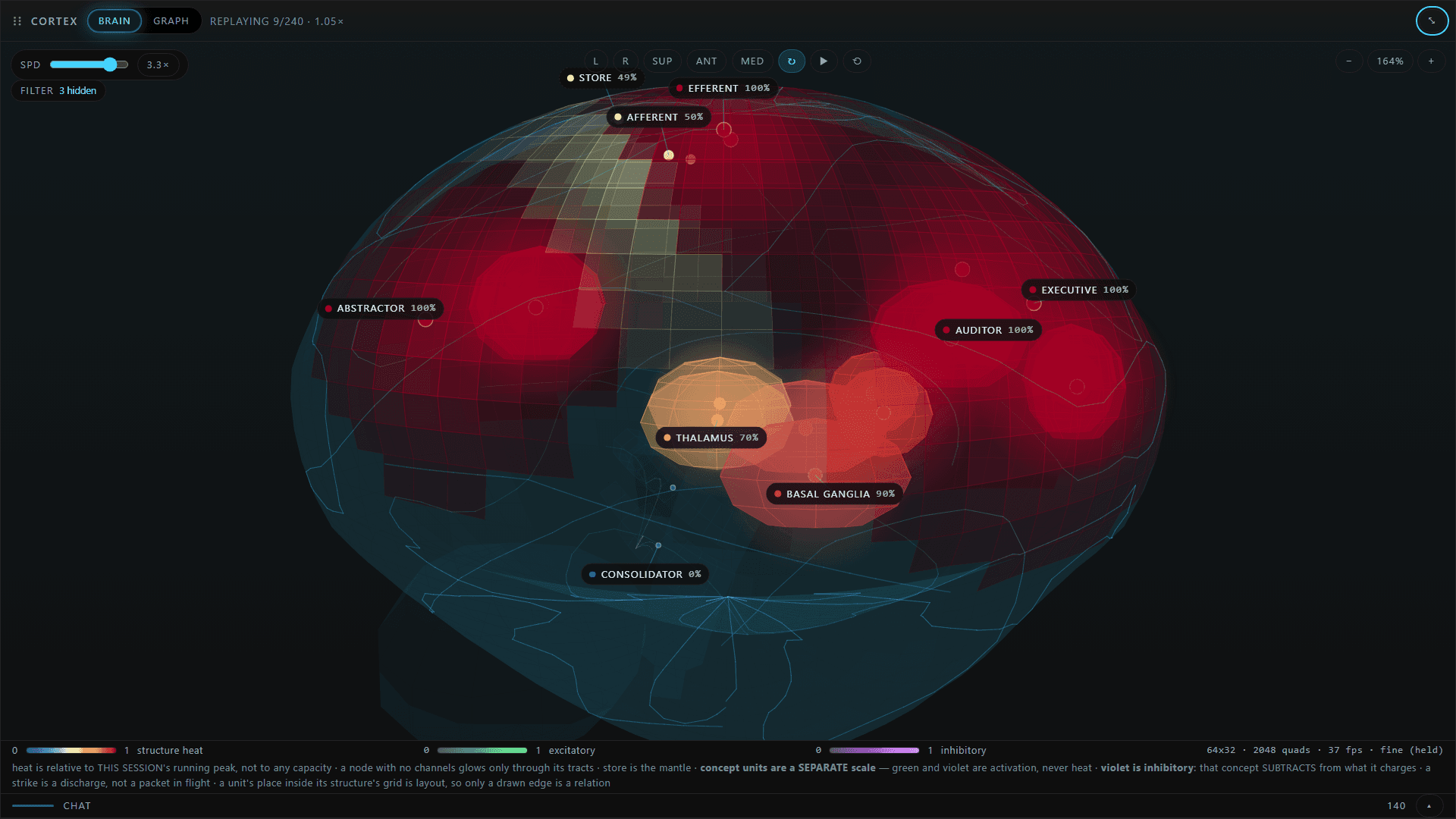
The brain surface: nine structures, each lit in proportion to the work it is doing
Our previous article, The Cognitive Layer Behind na8ve Models, described a memory process running underneath the parts of na8ve that students and teachers actually see. It held per-student values, updated them continuously, and stayed advisory by design: nothing it decided became a grade or a credential without a teacher or parent approving it first. What we didn’t show was what the process looks like from the operator’s side, or what it looks like scaled up from one student to an entire organization, school, or district. The console view is the screen a district’s technology director or an enterprise partner opens when they ask, “how is our school progressing towards next Quarter’s Local Control and Accountability Plan (LCAP) evaluation?” Cortex provides that visibility.
Traditionally, organizations use LMS systems, or SQL Server, Oracle, and Postgres to store data in digital tables similar to Excel sheets. This is the worst way to represent what an organization knows, because knowing and storing are not the same activity. A brain does not query itself with a “where is my memory” function. It simply notices, abstracts, and presents what you need. It forgets on purpose, to make room for what you’re currently focused on. It consolidates a hundred small observations into one useful generalization in a matter of microseconds, without scheduling when it will find the info and answer. Using machine learning techniques, Cortex operates much like a brain over past, present, and future data. It can be asked a question nobody thought to index in a traditional database, and produce the answer in text, presentation, and dashboard formats. Cortex is able to do this because everything it knows about your organization (the private local data store you provide it) is reasoned over using Large Language Models (LLM) alongside Machine Learning (ML) models which act just like neurons in the human brain. The best analogy of how Cortex works is to think of an automated Excel sheet program that continuously updates and presents data in real time based on what it sees happening in the real world.
We use neural networks and machine learning throughout, not a lookup table with search features. There is no field that filters data into separate tables waiting to be joined, like in SQL (Structured Query Language) search. SQL uses structured language to format, merge, and search through tables. Cortex goes beyond this by using actual natural language and learning models that think through live reactive dataflows in real-time, unlike the static SQL based software that we’ve been using for the past fifty years.
Continuous memory, with a direct view of the cognitive process
The design underneath Cortex is simple: model memory as neuronal plasticity, and stream updates to model weights directly to the console. Every screen, every presentation, and every agent works on an institution’s behalf using memory built from the organization’s data.
This opens the opportunity for true AI and organizational governance. Cortex has one memory because it holds facts that can be updated and change overtime.
This is the same principle our last article described about a single student’s model, extended one level up. A student’s memory holds only what has actually been observed about that student. An institution’s memory, in exactly the same architecture, holds only what that institution has actually told the system about itself: its own strategic plan, its own curriculum, its own culture: all standing facts and history collected from institutional knowledge, systems, and documents that are continuously updated, now available for analysis and predictions by the Cortex thinking datastore.
Institutional memory is not incidental to Cortex. It is half of what makes Cortex worth its enterprise value. The other half is what an organization can actually do with its memories: like watching dataflow updates in real-time, querying its knowledge store at any scale from individual student-level reporting to institutional strategic planning, and letting Cortex serve the organization as an agentic harness to improve productivity. Everything from planning, executing, and reviewing workflows can be done because Cortex models the organization as itself, once it is trained on institutional knowledge.
An AI built to be watched is auditable, and is the foundation of governance
The most valuable part of Cortex is its live view. This is the part that answers the question every serious evaluator eventually asks: “how do I know this is actually doing what it says?” That difference between being told the system is intelligent and actually seeing the brain work its processes is what separates Cortex from black box AI systems.
Open the console and you see the memory’s functional work laid out across a small number of cortical regions on the simulated AI brain, each one lighting up in proportion to what it’s actually doing at that moment. One region handles what just arrived and has not been interpreted yet. One plans a response and can call on the system’s tools to do real-world work. One only ever produces the final answer as a chat response, a fully reactive presentation slide, or custom generated analytics dashboard. See the higher level reasoning of the system separating consolidated observations, noticing inconsistencies, and generalizing across patterns. This is the same division of labor the last article described, now in a console you can watch in real-time.
Here is the console doing exactly that. This is an unedited session recording, played at ten times speed:
The Cortex console, recorded live and played at 10x
Fully integrated audits
The live view and the heat-map summary beside it are painted from the exact same values on the exact same update. Structurally, they cannot drift apart.
The entire system is on one screen
The console shows you the entire picture: a clear way to show which part of the system is working, not just how the underlying model is organized. It's also responsive to your interactions with it, providing real-time feedback.
Click through, not just look at
Every signal on the screen opens into what actually produced it: which process ran, what it read, what it wrote. Nothing on the console is a static picture. Everything is an audit trail of every action the system takes.
A separate agentic harness uses the brain
Cortex's real-time datastore is a memory and reasoning engine that any AI model (API or local open-weight models) can use. Any provider can be wired into the brain, saving costs since context grows linearly.
A system that manages how institutions engage with people should not be a black box to the people running it, and building the console this way is better than a simpler dashboard that only provides chat logs as an audit trail.
A reactive real-time cognitive datastore, not a database connected to a UI dashboard
Most institutional analytics is built the same way regardless of what it measures: something is logged, the logs are exported on a schedule into a database of static tables, and a dashboard runs search queries against those tables to answer questions about what already happened, sometimes hours after it happened. Cortex is built differently at the foundation. Its memory is reactive: when a fact changes, anything watching that fact, the live console, an aggregate view, another AI agent working on the institution’s behalf, updates immediately, the same way the console’s brain surface repaints the instant a brain region starts working. There is no nightly export, no refresh button, and no dashboard quietly serving a copy from three hours ago while the real record has already moved on. A human brain does not need to be told to refresh. It already knows, the moment something changes, because knowing and storing were never two separate steps to begin with.
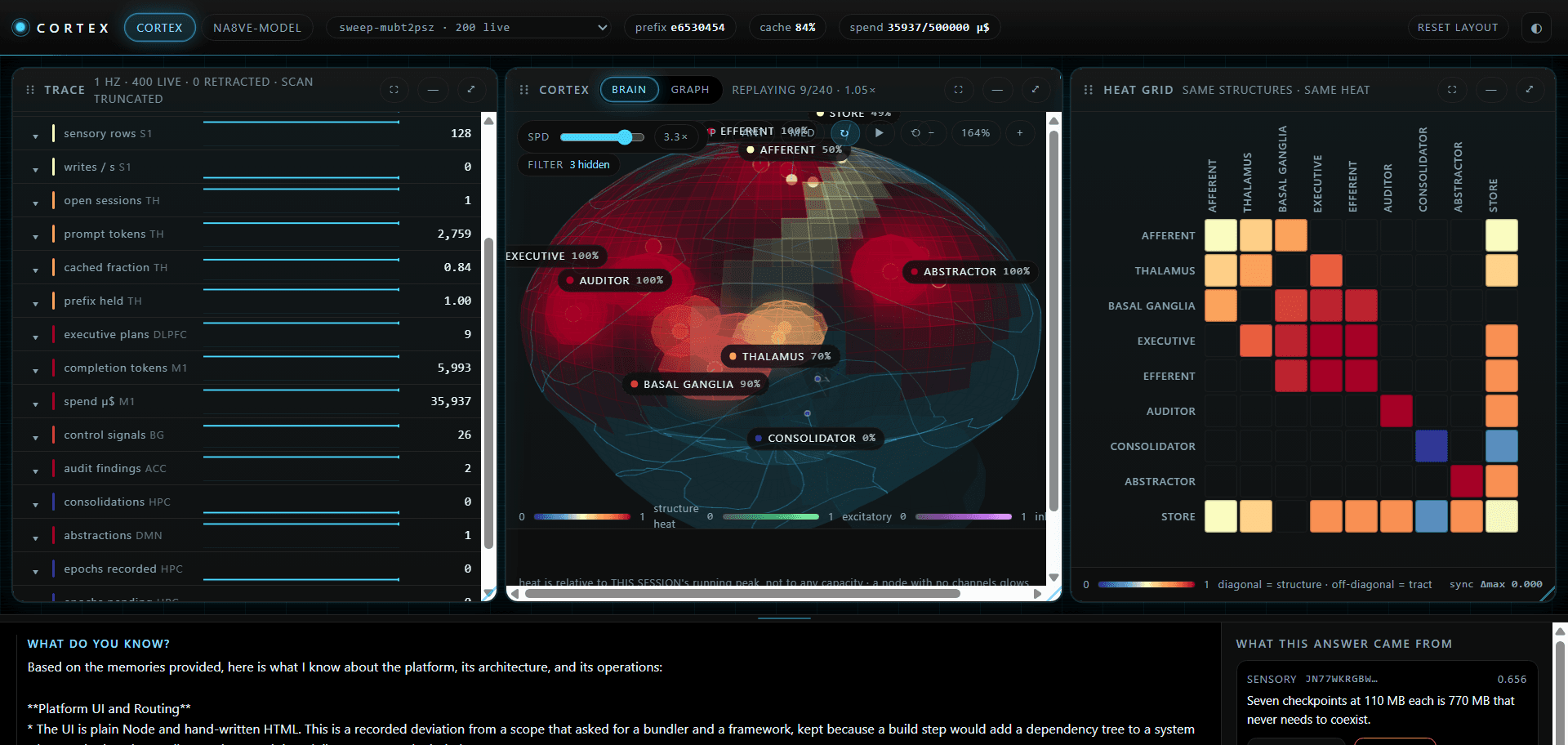
The console: trace panel, brain surface and heat grid, reporting in sync
This distinction matters most in real world situations where seconds mean the difference between success or failure. Updating the data and retracting the previous information needs to happen at the same time. In Cortex, a retracted fact is not just hidden from an individual view and left sitting in a batch table waiting for the next export; it is gone from the one memory everything reads, immediately, so an aggregate report built a minute later cannot surface it, because there is nowhere left for it to hide. A system built on static, batched tables has to remember to propagate a retraction into a second store on its own schedule, and in the gap between the two, an administrator and a compliance officer can be looking at different truths without either one knowing it. Cortex has one reactive memory, so that gap does not exist at all.
This is what we mean when we call Cortex a real-time cognitive datastore rather than a dashboard bolted onto a database. It is a streaming datastore built for what an AI system actually does: hold memory, change it constantly, and answer questions about it live, not a store of static rows that AI wrappers were added on top of. The console, the individual record, and the institutional analytics are three ways of asking that same live memory a question, not three separate systems an administrator has to trust agree with each other.
A model that represents the institution, not a generic one
An institution that adopts na8ve does not start from a blank slate, and it does not start from everyone else’s slate either. From the first day, it gets a Cortex space that belongs to no one but that institution, the same isolation architecture described above, and every fact that space accumulates came from that institution telling the system about itself: its own vocabulary for roles an AI agent would use, its own policies where a general default would not apply, its own precedent for a case that came up last year and may come up again.
What the model draws on to answer that institution’s questions is bounded by that space and nothing outside it. Nothing an institution tells Cortex is used to retrain a model shared across other customers, and nothing another customer has told their own Cortex space ever reaches this one. The memory an institution builds stays private to it in the same sense a retracted fact stays gone: this is an architectural property of one isolated memory per institution rather than one shared memory everyone draws from.
Over enough time, that adds up to something special: not a generic assistant with your logo added to a settings page, but a model whose working knowledge of your institution is actually institutional, accumulated the way a new employee’s understanding of your organization accumulates, from what the organization itself has said and done, consolidated the way a night of sleep turns a day’s scattered observations into something a person actually remembers.
Why the console matters more to a district than to a student
An earlier article in this series mapped na8ve’s features to specific findings from the Stanford SCALE Initiative’s 2026 evidence review, including its finding that AI-assisted tools work best, and are safest, when a human stays in the loop and the system’s reasoning stays visible to that human. That finding was written about classroom use. It applies just as directly, and just as forcefully, to the people who have to approve a system before a classroom ever sees it.
A superintendent, a general counsel, or an enterprise partner evaluating na8ve is not in a position to test whether a lesson is pedagogically sound. They are in a position to ask a narrower, answerable question: if this system makes an observation about a specific person, can you show me exactly what it observed, what it concluded, and who signed off on it, without asking me to trust a vendor’s word. Cortex is built to answer that question from the console itself, in minutes, because the answer already exists as part of what the system does, not as a report generated after the fact to satisfy a reviewer.
Put together, this is what a superintendent, a general counsel, or an enterprise partner is actually evaluating when they ask what na8ve does with an institution’s data: a governance layer that can prove what it knows and what it no longer knows, an analytics layer built from that same proof rather than a second system that has to be trusted to agree with it, and a model that comes to represent the institution because nothing it knows came from anywhere else. Those are not three separate systems. They are the same architecture, asked three different questions.
This is also why the console was worth building before anything else. A cognitive layer that only engineers can inspect is not a governed system, whatever its internal guarantees are. A cognitive layer whose reasoning a compliance officer can watch happen, in real time, on their own screen, is a different kind of presentation you can bring in front of a board.
The brain is the argument
Every AI system or database promises that their system is safe, transparent, and built with the right guardrails. That claim is cheap precisely because it costs nothing to say, but costs everything to the organization when it is not delivered. Cortex was built on the opposite premise: do not tell an institution the system is trustworthy, show them the memory, show them the reasoning, show them the moment a fact is withdrawn and the answer changes because of it, and let that be the fact.
The same premise extends past governance. Don’t tell an institution the analytics are accurate, show them that the analytics and the individual record are drawn from the same reactive memory and cannot disagree. Do not tell an institution the model understands their organization, show them that everything it knows about their organization came from their organization’s data and nowhere else, and that they can watch that memory being built, corrected, and used, live, in real time.
The Wizard’s answer to the Scarecrow, when they finally reached the Emerald City, was a diploma: a credential standing in for the thing he had actually wanted the whole journey. It worked in the story because the Scarecrow had been thinking clearly the entire way there and only needed to be told so. It is not enough here. An institution evaluating an AI system does not want a certificate that says the data is governed, analyzed, and understood. It wants to watch the thing actually think, which is the whole reason Cortex is a console and not a letter of compliance.
That is the cortex of the brain: not a feature added to a cognitive layer, but the proof of memory and reasoning working over information in real time.
Source: Stanford SCALE Initiative, “The Evidence Base on AI in K-12: A 2026 Review.”
This piece describes Cortex, the console, as we engineered, built, and used it: memory isolation, retraction behavior, and the live view are engineering properties we can show directly, not figures from a production research run. The complete na8ve research archive is published at na8ve.ai/research.
David Laurenvil is the developer of na8ve.ai. He previously served as Director of Education at the Fleet Science Center in San Diego, CA, and Executive Director of Kids MakeIt Institute, a 21st-century educational institution focused on exposing students to Science, Technology, Engineering, and Math (STEM) skills and careers.