
The education technology market has a pattern I recognize from inside it: a new kind of tool appears, early adopters adopt it, districts write policies about it, and the research arrives three years later to explain which parts of it actually worked and which parts were theater. We are in that window right now with AI in K-12 education, and the research is starting to arrive.
Stanford’s SCALE Initiative released The Evidence Base on AI in K-12: A 2026 Review, a systematic examination of what the causal research actually says about AI tools in education. It reviewed every rigorous study it could find, focusing specifically on research designed to measure whether an AI tool caused better outcomes, not merely whether users liked it or whether outcomes improved alongside it. The causal literature is thin, and the report is honest enough to say so. But what it does find is consistent enough to build on, and it maps almost exactly onto the design decisions na8ve has been making.
The central problem with general-purpose AI chatbots
AI tools that help students when used fail them the moment they are not. The researchers call this the distinction between “tool-supported performance” and “durable learning,” and the pattern appears across multiple independent studies and subject areas. Students using general-purpose AI chatbots performed substantially worse on closed-book exams than students with no AI access, even though they performed better during AI-supported practice (Bastani et al., 2025). Students who used AI chatbots to help with a writing task showed reduced brain activity and weaker recall afterward (Kosmyna et al., 2025). Students who used AI for research generated lower-quality reasoning and argumentation than peers who used traditional search (Stadler et al., 2024).
The mechanism is not mysterious. When an AI tool retrieves, organizes, and presents information for a student, the student does not have to do those things. The cognitive work those steps require, like the productive struggle that builds durable memory traces, never happens. The student feels like they learned because the session went smoothly, then three days later discovers that the knowledge is gone, because it was never moved from working memory to long-term memory. The skills produced through productive struggle were never encoded.
na8ve is built on this finding. Every feature described below exists because of it.
Adaptive Pedagogical Strategies
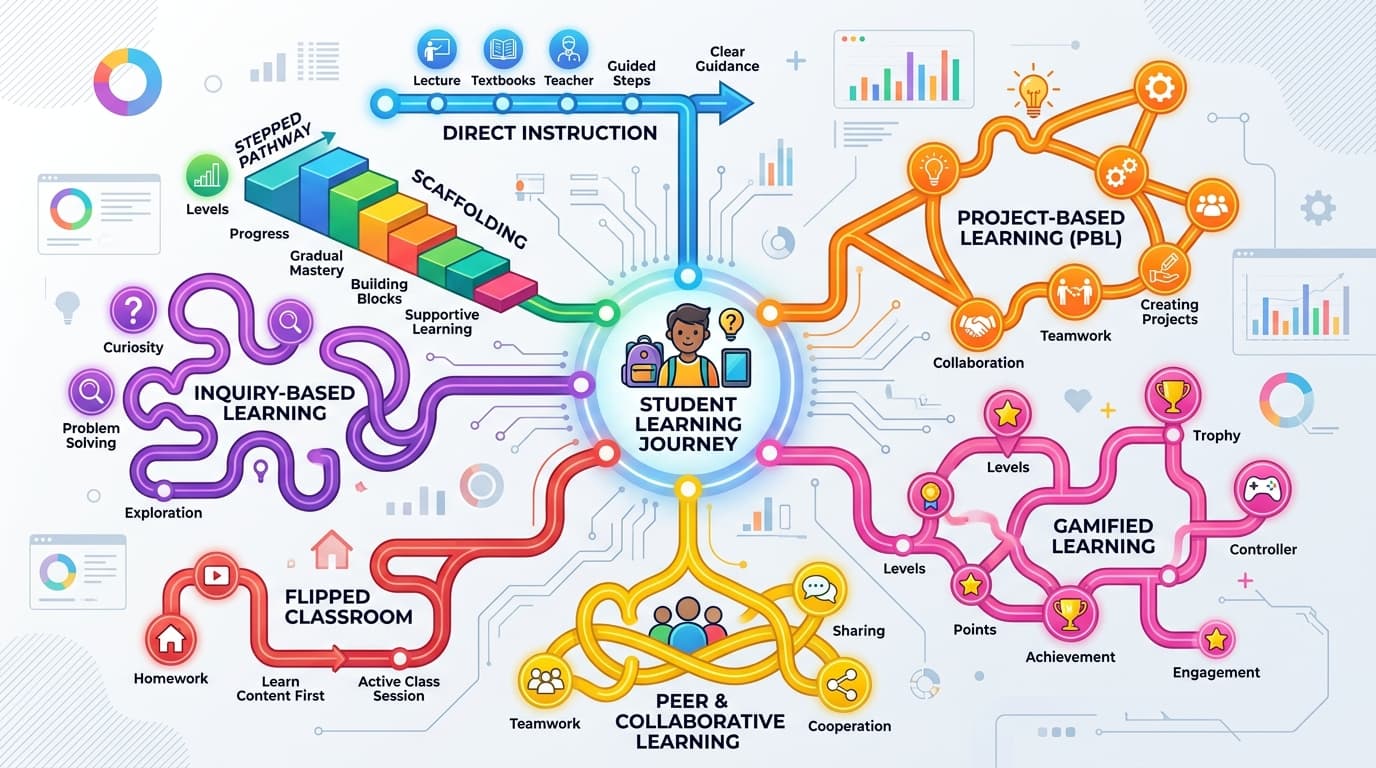
Adaptive pedagogical strategies
What most tools do, and why it is a bias. The edtech market has converged on a single answer to how AI should teach: Socratic questioning. Most next-generation tutoring platforms do it. It is a reasonable default. The Stanford research supports it for students who have sufficient background knowledge to be guided toward a conclusion through questions. But applying Socratic questioning to every student in every learning state is not evidence-based practice. It is one strategy applied universally, which means it is, structurally, a bias.
A child who does not yet know enough to reason toward a correct answer cannot be Socratically guided toward it. There is no path of questions that leads from zero background knowledge to a sound conclusion, because the questions presuppose the very background the student does not have. Asking a student to “think through why” a procedure works when they have a fundamental misconception about the procedure does not produce discovery. It produces frustration, or more often than not, an educated guess that the model then treats as evidence of understanding.
The same applies in the other direction. A student who is highly capable, deeply engaged, and ready to wrestle with a hard problem gains little from being walked through it step by step. The Socratic method that works for them is not guided questioning toward a known answer. It is open-ended collaborative exploration with someone thinking alongside them, proposing ideas as candidates, inviting critique, and leaving things productively unresolved to be revisited later.
Applying the same strategy to both students is not neutral. It underserves each of them in opposite directions, and neither of them are the average student the strategy was designed for.
What na8ve's models do instead. The models use a seven-strategy framework that selects a pedagogical approach based on what has actually been observed about a child; their current knowledge state, their metacognitive awareness, their anxiety signals, their engagement level, and whether they hold an open misconception in the domain. The selection is auditable: a teacher can see which strategy fired, why it fired, and the two data points from the student’s profile that produced the selection. Every selection can be overridden by the teacher.
The seven strategies are:
The seven strategies
| Strategy | How it works |
|---|---|
| Direct Instruction | Step-by-step explanation with comprehension checks after each step. No Socratic detours, since the student does not yet have the foundation to be led toward the answer by questions. |
| Socratic Questioning | Ask, don't tell. Scaffolds via questions. Prompts the student to justify each step. Fires specifically for students who have demonstrated they think about their own thinking well enough to be guided. |
| Worked Examples | Show one full example, then guided practice with hints, then independent practice. An open misconception cannot be resolved by asking a student to rediscover the correct procedure. They need to see it first. |
| Analogical Reasoning | Bridges from the success domain to the struggling domain via explicit analogy. Makes the structural similarity concrete rather than asking the student to notice it independently. |
| Productive Failure | Presents the challenge first and withholds direct guidance for the first few minutes, then reveals the target concept. Fires for students who are ready to be challenged. Requires high engagement and a strong achievement orientation signal that being challenged will motivate rather than demoralize. |
| Anxiety Reduction + Scaffolding | Warm tone. Small wins are sequenced first. Explicit framing of the session as exploration rather than assessment. Comprehension checks replace challenge checks. Fires when the student's affective state is the variable preventing learning, not their underlying knowledge. |
| Collaborative Exploration | This is for students who are ready to think alongside the teacher rather than be led by one: “Let's figure this out together” framing. Proposes ideas as candidates and invites critique. Treats the session as a shared intellectual project rather than a guided sequence toward a known answer. |
Why this matters for equity. The bias embedded in general-purpose models is not random. It falls most heavily on the students who are already most underserved. A student with high test anxiety who gets Socratic questioning in a high-stakes moment feels interrogated and learns less, because the strategy increases cognitive load rather than reducing it. A student with a foundational misconception who gets collaborative exploration confirms the misconception in a warm, collaborative environment. A beginner who gets productive failure gets stuck, unproductively, because they do not have the grounding to make use of the impasse. In each case, the wrong strategy produces outcomes that look like the student’s limitation rather than the tool’s.
Our model’s approach does not eliminate this entirely. The model is wrong sometimes, and the teacher sees the rationale precisely so they can catch it when it is. But it removes the structural bias of assuming that what works for the average student works for every student, which is the same structural assumption that makes general AI models unfair to the students who are not that average student.
What the research says. The Stanford review examined a study comparing two versions of an AI tool: one built with Socratic guardrails (guiding reasoning through hints and questions) and one that gave students direct answers (Blasco & Charisi, 2025). The direct-answer tool was rated as more helpful by students in the moment. The Socratic tool produced better outcomes when students were later assessed without AI access. The Stanford authors summarize: students often prefer tools that give them the answer, but tools that make students do the reasoning are the ones that produce learning that lasts.
The learning science framework that the Stanford report applies here is Vygotsky’s Zone of Proximal Development, which is the optimal range between what a student can do alone versus what they can achieve with support. Effective scaffolding keeps a student working at the edge of that zone and gradually releases responsibility as the student builds capability. The expertise reversal effect (Kalyuga, 2007), which the Stanford report also cites, explains why the same scaffold that helps a novice can harm an expert: worked examples that reduce cognitive load for a beginner generate interference for an advanced learner who would benefit more from solving without a template. na8ve’s strategy is an implementation of this principle. The strategy chosen by the model is the one calibrated to the student’s current position in their learning trajectory, not to the average student’s position at grade level.
The teacher's override. A teacher who disagrees with the selected strategy can pin a different one, and the model works inside that pin before re-evaluating. The strategy selection rationale is the mechanism by which the teacher can evaluate whether to agree. A teacher who knows their student is having a hard day emotionally can pin Anxiety Reduction before the session starts. A teacher who believes their student is ready to be challenged can pin Productive Failure. The model’s recommendation is a starting point that the teacher is always entitled to revise.
The Isolated Personal Learning Model
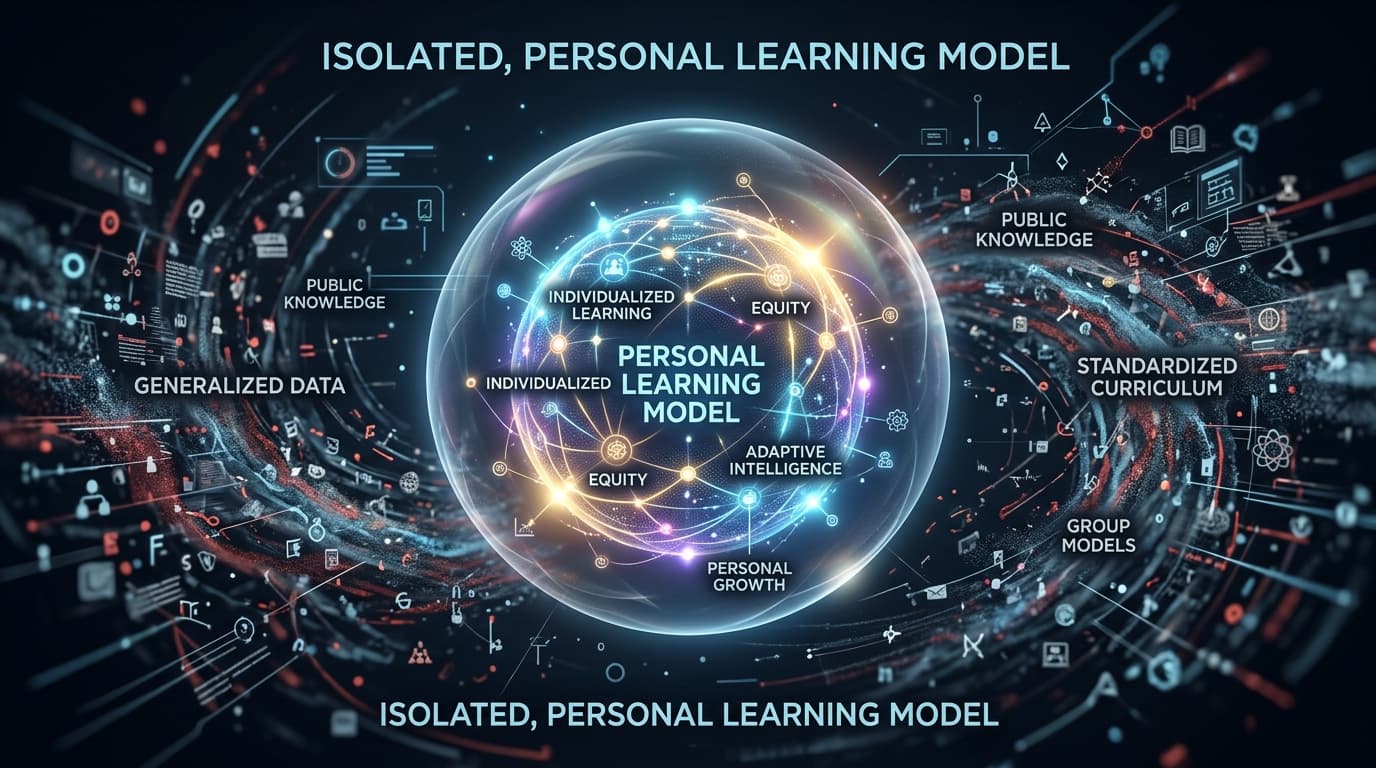
The isolated personal learning model
What it does. Every student on na8ve has a small model that is theirs alone. It contains only what has been observed about that student. It does not average them into a cohort, does not compare them to a median, and does not carry observations from any other student. When the model makes a recommendation, it is a recommendation based on this child’s actual learning history.
What the research says. The Stanford review identifies equity as one of the central unresolved questions in AI education research. It notes that AI tools are “optimized for English and may provide lower-quality or biased support for English Learners,” and that students with learning needs, English language learners, and students with disabilities “could all potentially benefit from AI support in the right context”, but that the current evidence does not examine impacts for these groups.
The reason the current evidence does not examine these impacts is structural: it is very difficult to measure harm from a general model, because the harm is not a bug or a failure event. It is a continuous calibration problem. Every general model must assume something about the student it has not yet observed. What it assumes is the average. Every student that deviates from the average gets measured against someone who has a different pace, a different native language, a different set of processing strengths. When these general models respond, they are usually answering a question about someone else.
Isolation is not the only way to address this problem, but it is the most structurally complete way. The personal learning model also focuses on accelerating learning through targeted calibration of relevant parameters.
Key parameters of the personal learning model.
For every child, and for every individual skill that child is building, the model focuses on four things: how confident it is that they have the skill, how long it thinks the knowledge will last before they forget it, whether the skill has become automatic or still costs them visible effort, and how fatigued they are while working on the problem. Notice that a grade answers none of these. A grade tells you what happened on a specific test, but what’s absent from a grade is what a child needs in order to develop and retain a skill. A grade can make a statement about how a child did on a specific lesson, but their personal model asks a different question. The model wants to know how that student learns, and it exists to accelerate learning for one specific child. Not engagement, not time in the app, not completion percentage, but the thing education was created to provide: learning.
Confidence
Probability of genuine mastery; not whether the student got it right once, but whether the acquisition is stable. Updated by every observation made.
Retention
How long the knowledge is expected to last before the student forgets it. Schedules a review at the edge of forgetting. This is when a review is worth the most.
Fluency
Whether the skill has become automatic. Response latency is measured against this student's own baseline, not the class average, not the median.
Fatigue
Current cognitive state. High fatigue is flagged and surfaced, not buried. This provides support to reduce stress.
Why Fluency is measured against the child's own baseline. This is the most consequential fairness decision in the model. A student who reads at the 30th percentile for their age may answer a comprehension question in two minutes instead of forty-five seconds. In any model that measures against the median, every answer that child gives comes back marked delayed; permanently, regardless of how strong their comprehension actually is. The model starts prescribing speed interventions for a child whose comprehension was never the problem. English learners carry the same burden for the same reason. Children with processing differences carry it too. na8ve models compare each student against their own previous pace instead. Our model simulations include delayed-and-accurate students specifically so that any accidental regression to the median comparison is caught immediately.
Conservative Progression and the Review Schedule
What it does. na8ve will not advance a student to new material while foundational skills are slipping. The model monitors retention on every previously covered skill and can trigger a review when it estimates a skill drops below a memory threshold. Review sessions are timed to land near the edge of forgetting, the point at which a review produces the largest gain in memory stability.
What the research says. The research on spaced retrieval practice is among the most replicated findings in cognitive science. Reviewing something just before you would have forgotten it is worth dramatically more than reviewing something you still remember comfortably. Comfortable review feels productive and encodes almost nothing new in memory. Reviewing at the edge of forgetting, that moment when retrieval requires actual effort, can multiply the expected duration of the memory by factors of three or more.
This finding has a counterintuitive implication for what progress should look like. A student whose schedule is working correctly will sometimes go a week or three without seeing a skill they have covered. This looks like neglect, but it’s not. It’s the model waiting for the moment the review is worth something. A student who reviews everything every day is wasting time on material they have not had time to forget, while previous materials they learned and need to consolidate slip away unscheduled.
The Stanford report captures this in its learning science framework:
na8ve’s conservative progression rule is the structural implementation of this principle. When the model sends a student back to review, it is not issuing a judgment about the student. It is reading the memory state and acting on what it finds. Our own research recorded the decision that most clearly illustrated this: Cleo, a simulated student who had just submitted her best work in seven weeks, was sent back to review two older skills that had quietly dropped to 49% confidence while she was succeeding at something new. The model refused to advance her onto unfamiliar ground while the ground behind her was giving way. The author’s instinct said move her forward, but the model was right.
The Open-Weight Audit Trail

The open-weight audit trail
What it does. Every recommendation na8ve makes is accompanied by the full chain of reasoning that produced it. The observations the model made, the weights it applied, the calculation that produced the score, and the conclusion it drew are all visible and readable. A teacher or parent can trace any number on the insights dashboard back to the individual observations that fed it.
What the research says. The Stanford review found that educator-facing AI tools are among the most evidence-backed applications of AI in K-12, specifically because they augment rather than replace human judgment. Studies show teachers who had access to AI writing feedback tools discussed more essays individually with students where the AI handled the routine assessment, and the teacher reinvested the time in higher-quality one-on-one interaction (Ferman et al., 2021). Teachers using AI for lesson planning spent 27–31% less time on preparation with no detectable quality loss, and more importantly, their use of AI decreased over time while savings persisted, suggesting they quickly learned where AI adds genuine value and deployed it more selectively (Roy et al., 2024).
The common thread across the effective educator-facing tools is that the human remains the decision-maker. The AI supplies information the human uses to make better decisions, faster. This only works if the human can actually evaluate the AI’s information. Teachers need access to see the reasoning, test it against what they know about the student, and push back when it is wrong.
The na8ve model audit trail is the mechanism that makes human mediation possible rather than nominal. Without it, the teacher can see the recommendation but cannot evaluate it. They must either follow it blindly or override it blindly, both of which are guessing at features within a black-box. The audit trail means the teacher can read the argument, check it against what they know, and make an informed decision.
Human-in-the-Loop Approval
What it does. Nothing that na8ve generates for a student reaches the student without the teacher’s or parent’s approval. Lessons are drafted and presented for review. The teaching approach the model takes is given to the teacher to approve. The model’s recommendations can be read, questioned, overridden, and ignored.
What the research says. This is the finding the Stanford review states most clearly, and the one with the most consistent support across independent studies. The report identifies what we term an “engagement cliff”: the drop-off in engagement and outcomes that happens when students use AI tools without a human structure around them. Tools embedded in human accountability structures (a parent who checks the dashboard, a teacher who reviews the week’s lessons, a microschool pod where the operator sees the progress data) consistently outperform tools given directly to students without that layer.
The mechanism is not simply motivation, though motivation is part of it. The Stanford report points to something more structural: students who know a human is reviewing their work approach it differently. The AI tool becomes part of a relationship rather than a replacement for one. And the human review catches the failures the AI cannot catch, such as the times when the model’s recommendation is mathematically correct but contextually wrong, or when the model has stopped working correctly and can make it look like the student is struggling.
AI without human structure
Students disengage in a pattern that resembles the tool running out of things that are relevant for the student. Engagement drops sharply over weeks. Performance gains during access do not transfer to independent assessment. The AI cannot distinguish between a student finding the work hard and a student it has stopped serving.
na8ve with human-in-the-loop
Teacher or parent reviews and approves lessons before they reach the student. Dashboard surfaces model reasoning in readable form. Teaching approach is pinnable and overridable. The human catches what the model cannot observe: context, emotional state, external knowledge about the child.
Privacy-First Architecture, With Equity in Mind
What it does. Student cognitive profiles in na8ve are isolated by design. The model that belongs to your child does not share data with any other student’s model. Observations about how your child learns (their pace baseline, their retention curves, their fatigue patterns) are not pooled into a dataset that trains a general model. The data exists for one purpose: to serve that child’s learning and achievement.
What the research says. The Stanford report is candid about one of the largest gaps in the current AI education evidence base: the equity effects are almost entirely unstudied. The report notes that “few studies examine equity effects in the current causal literature,” and that the questions most important for equity — whether AI tools disproportionately benefit students who already have strong preparation, whether tools are accessible to English learners, whether students with IEPs or 504 plans are served rather than sorted — remain open.
The absence of evidence is not evidence of no harm. General models trained on broad populations carry whatever distributions those populations have. A model trained primarily on data from one kind of student will be most accurate for that kind of student, and its errors will be nonrandom. They will fall on students who are least like the training population. Students from underrepresented backgrounds, students with disabilities, students from non-English-speaking households: these are the students the equity questions are about, and they are the students for whom a general model’s defaults are most likely to be wrong.
Decentralization to individualized personal learning models does not solve every equity problem. Access remains a constraint, as does digital literacy, as does home connectivity. But it removes the structural source of error that is hardest to see and hardest to correct: the implicit comparison to a student who is not your child.
What the research cannot yet say
The Stanford report is explicit about the limits of what the current evidence base supports.
Effect sizes outside active tool use are inconsistent. Several studies find that gains during AI tool use do not transfer to independent performance. na8ve’s design addresses this through pedagogical guardrails and spaced retrieval. But we have not yet demonstrated this with real students over real time. Our research cohort uses simulated students for training purposes to predict learning trajectories. This proves the model responds correctly to evidence of learning. It does not prove that our lessons cause learning. That evidence requires real students over real months.
The evidence is concentrated in older students and math. The Stanford report notes that 35% of causal impact papers focus on math skills, and that postsecondary settings are over-represented. The evidence for elementary students, for subjects outside math and literacy, and for students with IEPs is thin. na8ve’s current research cohort exercises a fractions curriculum at one grade band. Generalization beyond that is a claim the current data does not support.
Human mediation requires an engaged human. The finding that human-in-the-loop structures improve outcomes assumes a human who actually reviews the dashboard, reads the audit trail, and makes meaningful decisions. A parent who approves lessons without reading them has not brought human judgment into the loop. The tool’s design makes engagement easy; it cannot make it happen.
The design principle that runs through all of it
Every feature in na8ve was designed around a single commitment: that the model’s job is to accelerate learning, not to replace the cognitive work that learning requires. Spaced retrieval at the edge of forgetting, not comfortable review on demand. Pedagogical guardrails and student agency, not direct answers. An audit trail that a teacher can read and push back against, not a black box that issues verdicts. A model that belongs to the student and measures only against the student, not one that assumes the student in front of it is the average student it was trained on.
The Stanford evidence base, taken together, suggests that these commitments are the right ones. The tools that fail are the ones that relieve cognitive load indiscriminately, replace human judgment with algorithmic certainty, and treat all students as interchangeable inputs to the same model. The tools that show durable effects are the ones that sit behind human educators, surface structured guidance rather than completed work, and make their reasoning visible enough to be acted upon.
That is the tool we are building, and the research is the reason we are building it that way.
Sources: Stanford SCALE Initiative, “The Evidence Base on AI in K-12: A 2026 Review.” Individual study citations: Bastani et al. (2025), Blasco & Charisi (2025), Chen et al. (2025), Degen et al. (2025), Ferman et al. (2021), Kosmyna et al. (2025), Kreijkes et al. (2026), Roy et al. (2024), Stadler et al. (2024).
The complete na8ve research archive, including the wave-by-wave cohort data and prediction records cited above, is published at na8ve.ai/research.
David Laurenvil is the developer of na8ve.ai. He previously served as Director of Education at the Fleet Science Center in San Diego, CA, and Executive Director of Kids MakeIt Institute, a 21st-century educational institution focused on exposing students to Science, Technology, Engineering, and Math (STEM) skills and careers.